
The course
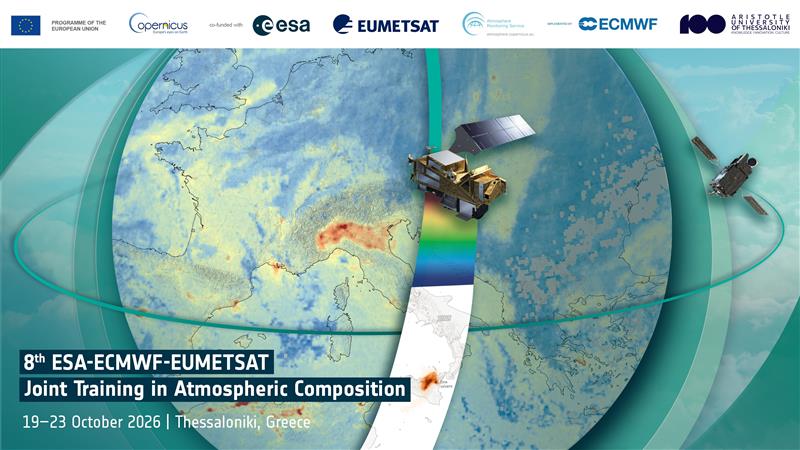
The European Space Agency (ESA), the European Organisation for the Exploitation of Meteorological Satellites (EUMETSAT), the European Center for Medium-Range Weather Forecasts (ECMWF) with the Copernicus Atmosphere Monitoring Service (CAMS) are organising the Eighth annual Joint Training on Atmospheric Composition, hosted by the Laboratory of Atmospheric Physics, School of Physics, Faculty of Sciences, Aristotle University of Thessaloniki, Greece from 19 to 23 October 2026. Greece from 19 to 23 October 2026. The course builds on nearly a decade of rich heritage, and past examples of trainings, including pre-training webinars can be found in the following sections of this website.
Specific Goals
The training will introduce the participants to state-of-the-art satellite remote sensing, ground-based and in-situ measurement techniques for atmospheric composition monitoring and chemical transport modelling in a global context. This year the course is focused in the Remote Sensing of Air Quality, and the key topics will include:
- The recently launched Sentinel-4 and Sentinel-5 missions
- Tools and techniques for retrieving concentrations of pollutant gases from satellites
- Principles of atmospheric chemistry/dynamics and relevance on climate and air quality
- Combining data from different satellite instruments
- Methods underlying how high-quality satellite retrievals can improve the reliability of air quality models and forecasts
- Science communication
- Additional aims include fostering collaboration amongst participants and encouraging the development of individual and team projects using the data, resources and methodologies present
Target audience
The training is of interest for PhD students, early-career scientists, researchers from academia and research institutes, industry, and anyone interested in atmospheric composition monitoring and modelling. On site training participation is limited, and selection is competitive.
We are pleased to announce that the webinars prior to the in-person training will be accessible to all. Basic knowledge in the concept of remote sensing and working knowledge of python is expected.
Participants from ESA, EUMETSAT and ECMWF member states are given preference for the in-person training; however, participants from all other countries are also welcome to apply, subject to availability of space.
Important
The training is free to attend. However, participants selected for the in-person training will be expected to cover their own travel and subsistence costs and bring their own laptops. On-site participants will receive a certificate upon completion of the training.
Financial support (for accommodation in Thessaloniki) will be available upon request for a limited number of participants. Priority will be given to candidates from Copernicus contributing countries or to those working on an EU project using Copernicus data.
The School of Natural Sciences, is fully mobility accessible, and the training is inclusive.
Format
The training is taking place partially online with preparation lectures in the two weeks before the physical meeting, and 4.5 days of physical meeting in Thessaloniki, Greece. The training will consist of the following components:
Online preparation (open to all)
- Online lectures / demonstrations with keynote speakers
- question & answer sessionOn-site preparation (selected participants)
- Open discussions
- step-by-step interactive data discovery
- instructor- lead software demonstration
- team projects design and development
More information on the joint school and registration is available here.
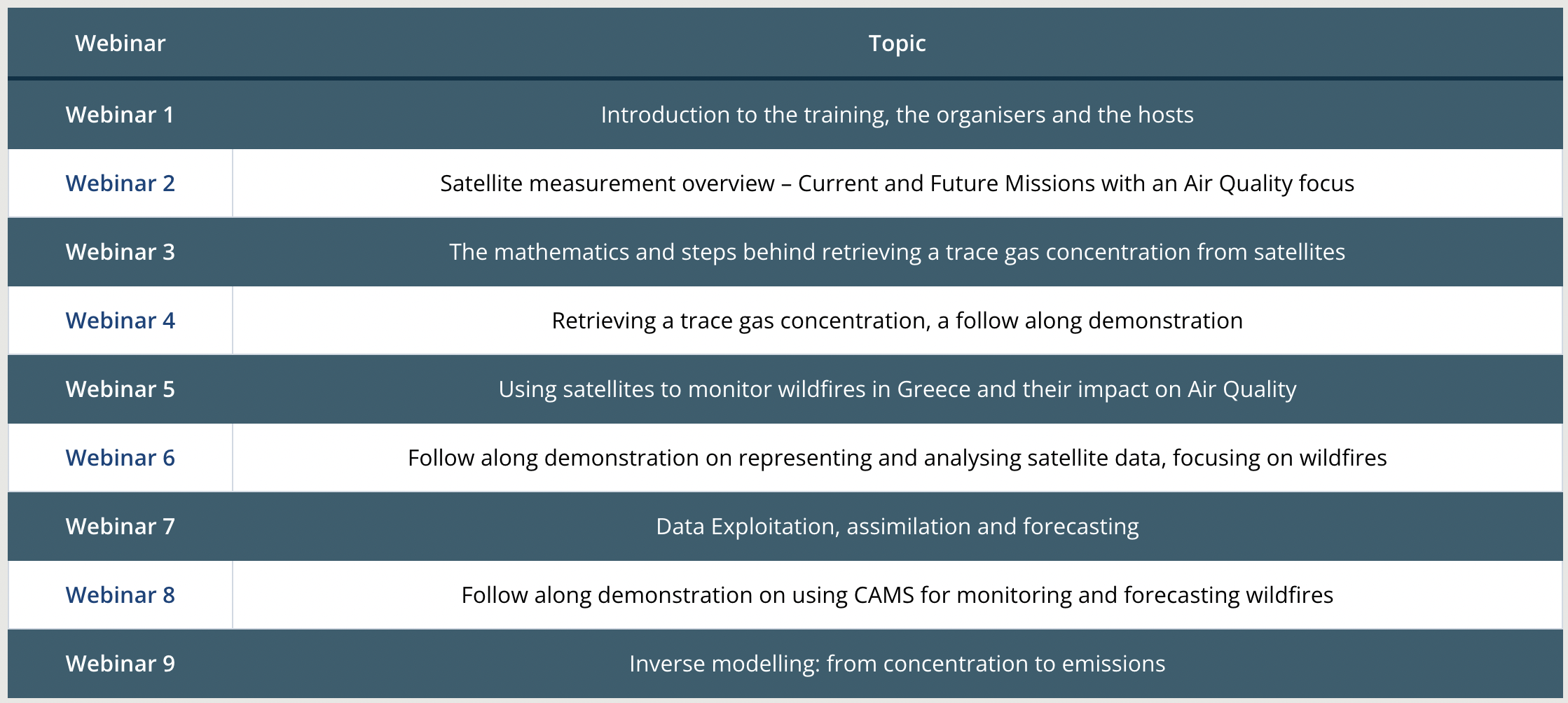
Webinar Program
Dates: 5-16 October 2026
On-Site Program
Dates: 19-23 October 2026
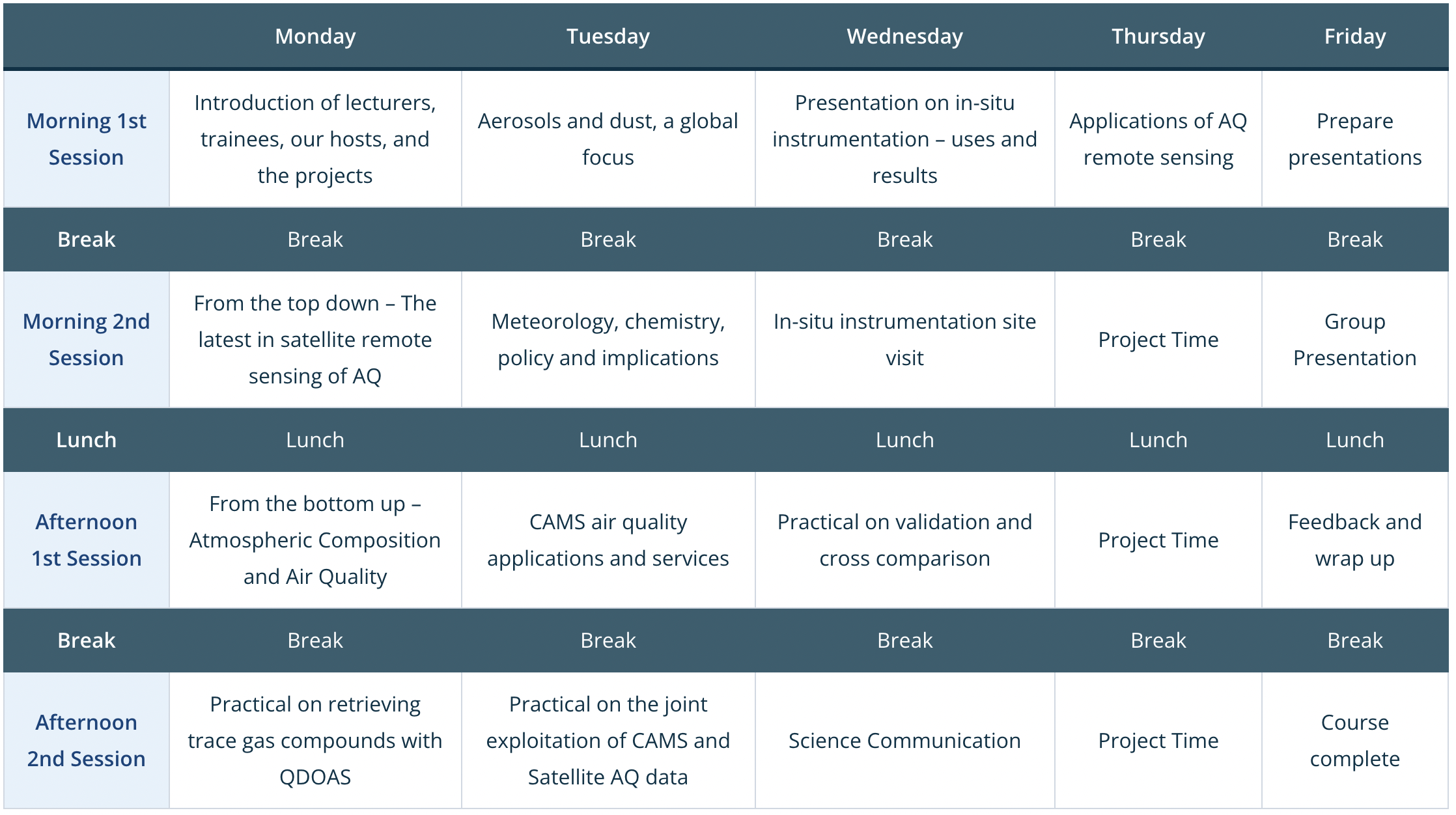
Lecturers and Speakers
Dimitris Balis (Aristotle University of Thessaloniki)
MariLiza Koukoli (Aristotle University of Thessaloniki)
Dominika Leskow-Czyzewska (EUMETSAT)
Eduard Malina (ESA)
Noemi Marsico (Evenflow for EUMETSAT)
Kostantinos Michailidis (Aristotle University of Thessaloniki)
Bas Mijling (KNMI)
Sander Niemeijer (S&T)
Mark Parrington (ECMWF)
Manolis Proestakis (NOA)
Chrysanthi Topaloglou ((Aristotle University of Thessaloniki)
Jeroen van Gent (BIRA)
Prodromos Zanis (Aristotle University of Thessaloniki)
Organizers and Support
Daniele Gasbarra (Shamrock Space Services for ESA)
MariLiza Koukouli (Aristotle University of Thessaloniki)
Dominika Leskow-Czyzewska (EUMETSAT)
Sabrina Lodadio (Serco Spa for ESA)
Edward Malina (ESA)
Noemi Marsico (Evenflow for EUMETSAT)
Kostantinos Michailidis (Aristotle University of Thessaloniki)
Mark Parrington (ECMWF)
Chris Stewart (ECMWF)
Schedule and Deadlines
| Applications opening : 26 March 2026 |
| Applications closure: 15 May 2026 |
| Notification of acceptance: July 2026 |
| Issue of Preliminary Programme: August 2026 |
| Issue of Final Programme: at the training course |
| Training Course: 19 (morning) – 23 (lunchtime) October 2026 |
Venue & Logistics
Laboratory of Atmospheric Physics, Aristotle University of Thessaloniki, PO Box 149, Campus A.U.TH
54124 Thessaloniki
Accomodation
Please find below a list of suggested hotels closest to the Department area. Rooms can be booked upon availability by contacting the hotels below directly.
Casa Primavera – Guest Reservations
Abc Hotel Θεσσαλονίκη | Ξενοδοχείο στο Κέντρο, Κοντά στη ΔΕΘ
ΤΟ ΞΕΝΟΔΟΧΕΙΟ – Orestias Kastorias Hotel Thessaloniki